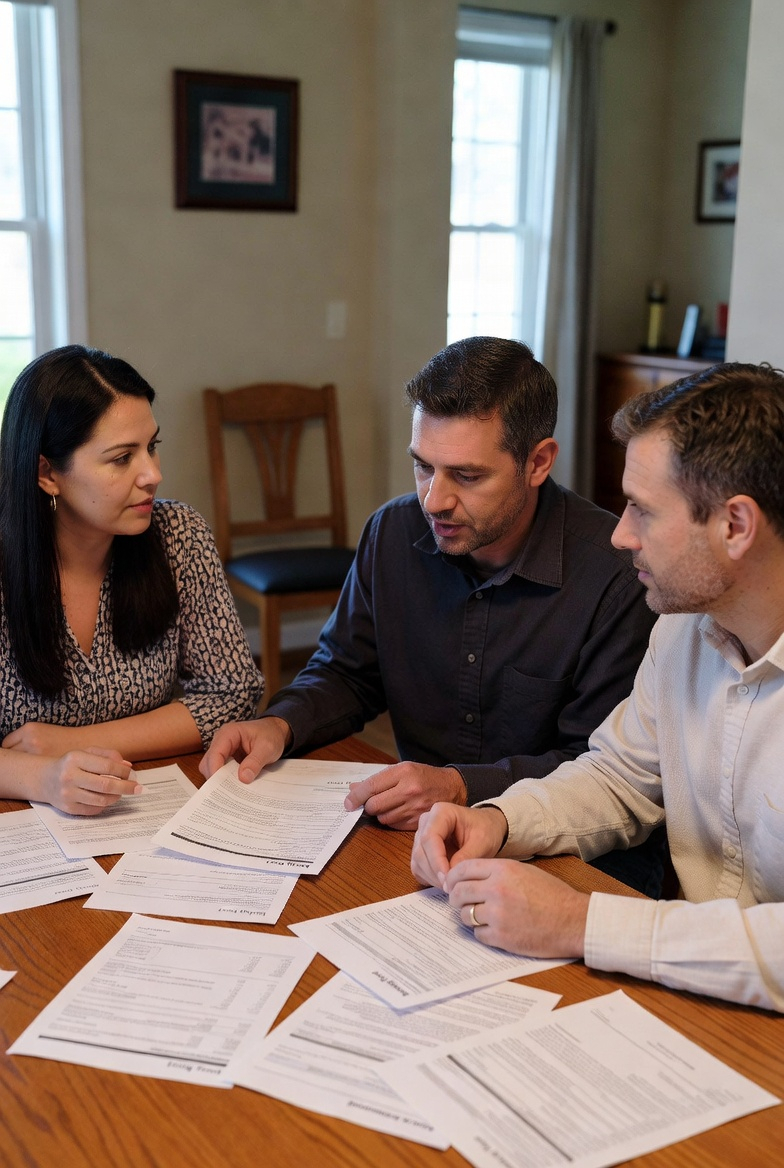
What to Do With the Family Home in a California Trust Administration
What happens to the family home during a California trust administration: keep or sell, Prop 19 reassessment, capital gains, and practical steps.

In California, the family home will go through probate unless it is in a living trust. As a result, people with living trusts transfer title of their home to their trust. So when the grantor dies, the successor trustee has to deal with the family home. It doesn’t have to be a complicated asset to administer, but certainly is more complicated than cash.
Two Initial Tasks
As the successor trustee, there are two initial tasks you must complete when dealing with the home.
First, you need to sign, notarize, and record an Affidavit Death of Trustee, which is a document that says the grantor has died and you are now the trustee. The Affidavit is a public record establishing that you, as the successor trustee, have authority over the property. When you eventually sell or transfer the property to a trust beneficiary, the Affidavit gives you authority to sign the deed.
Second, file with the county assessor a form called Change in Ownership Statement – Death of a Real Property Owner (Form BOE-502-D). When you record the Affidavit Death of Trustee, you are making a public record that the trustee has died. You'd think that would be sufficient notice to the county, but no. You also need to file this.
These two filings are just the start of the administration — see our California Trust Administration Checklist for everything else you're on the hook for.
When you've completed these initial tasks, you need to determine what to do with the home. Do you sell it, or do you distribute it to the beneficiaries? What does the trust say? Does it say to distribute the home to one of the children, or, most likely, is it, along with all the trust assets, to be distributed equally to the children?
This is when you, as trustee, earn your trustee fee. If the trust has no specific instructions about the house, then it's your call whether to sell or transfer title to the beneficiaries. What do they want? Do they want cash from the sale, or do they want to keep it? By now you should already have a rough value for the home from your trust inventory.
Homeowners Insurance During the Administration
Don't assume the parent's homeowner's policy just keeps running. Many policies restrict or void coverage once a home sits vacant for 30 to 60 days, which is exactly what happens while the home sits empty during a trust administration. Call the homeowner's insurance company as soon as you're acting as trustee, get the named insured updated to the trust, and ask directly whether the policy still covers a vacant home or whether you need a vacant-dwelling policy instead. It's a five-minute phone call that prevents an uninsured loss.
The Existing Mortgage
If there's still a mortgage on the house, you, as trustee, need to keep making the payments during the administration from the trust bank account.
If the home is sold, the loan gets paid off out of escrow.
But if the beneficiaries decide to keep the house instead of selling it, the mortgage company may call the loan because the borrower, the grantor, has died. If that happens, the beneficiary keeping the house will need to qualify for and get a new mortgage in her own name once title is transferred to her. This is usually enough to push a family toward selling. Even beneficiaries who'd rather keep the house often can't just step into the parent's old loan; they need all-new financing at today's rates, and that can be a deal breaker that compels a sale.
Keep It or Sell It
The decision almost always turns on Proposition 19. In the years before Prop 19, children could inherit the family home and keep the parents’ low property-tax base. A house bought in 1975 for $30,000 might still be generating a tax bill under $500 a year even after the parents died. Today that same house, now worth $2 million, is typically reassessed at current market value, and the new tax can jump to roughly $25,000 a year. That is a big change.
There is still a limited parent-child exclusion if a child moves in within one year and files the required claim forms, but it is capped and comes with strict conditions. For the full current rules, see our complete guide to Proposition 19 and Your California Home.
As trustee, you have to sort this out with the beneficiaries. Does anyone want the home as their primary residence? Are there enough other assets to equalize the shares without a cash buy-out? If a buy-out is needed, the money the occupying child pays her siblings is treated as a sibling-to-sibling purchase. That portion loses the parent-child exclusion and gets reassessed at today’s value.
Example. The trust holds a $1 million home and a $1.2 million brokerage account ($2.2 million total). Three equal beneficiaries each have a $733,333 share. If one takes the home, she is $266,667 over her share. She must pay each of the other two $133,333 from her own funds. Roughly 27% of the house is now treated as purchased from the siblings, so that slice is reassessed, while the remaining 73% can still qualify for the exclusion, provided she moves in within one year and files the paperwork with the county.
Because of that math, many families simply sell. Even a child who wants the house often cannot absorb the new tax bill or the equalization payment.
Financing a Buy-Out
There is a way to equalize the shares without triggering the partial reassessment described above, but it only works if the loan is taken out by the trust itself, not by the beneficiary who is keeping the house.
The trust borrows against the property using a specialty trust-administration loan (these are not standard mortgages; they cost more and usually must be refinanced within a year). The trust then distributes the loan proceeds to the other beneficiaries as their cash share and distributes the home to the remaining beneficiary subject to that debt. Because the trust is doing both the borrowing and the distributing, there is no sibling-to-sibling purchase, so the reassessment trigger does not apply.
The beneficiary who ends up with the house must then refinance the trust-level debt into a conventional loan in her own name. This approach only works if she can qualify for that refinance and if everyone is comfortable with the higher cost and complexity of the specialty loan on the trust.
No Capital Gains Tax
If you sell the home, there shouldn't be a capital gains tax because of the step-up in basis when the decedent died. Under Internal Revenue Code §1014, an inherited asset's basis resets to its fair market value on the date of death. If the home was titled in the decedent's revocable trust, and not in an irrevocable bypass trust, there will be a step-up in basis and no capital gains tax on the sale.
Get an Appraisal If Not Selling Right Away
The step-up in basis is the property's date-of-death value, so you need to get a date-of-death appraisal. A realtor's comp survey won't cut it. You need a legitimate appraisal that the IRS will respect. An appraisal by a certified appraiser will certainly fit the bill. We have also found that an appraisal from a California Probate Referee will suffice. A California Probate Referee is an appraiser who has been vetted and chosen by a county probate court to value assets for probate. Most probate referees will accept side work outside probate, such as a trust administration, and their fees are very reasonable.
If you will sell the home shortly after the date of death, you won't need an appraisal. An appraisal is a best guess of the price a third party will pay for the property. It's an estimate based on sales data of similar homes and market conditions. But the true value is the price a real buyer pays for the property. If you sell it soon after the date of death, then the sale price is a more accurate value than an appraisal. But this only works if you sell soon after the date of death and the market is flat. If you sell it one year later and property values are soaring, then you will need an appraisal.
Get a Realtor
As trustee, it's your job to choose a realtor to list and sell the home. Sometimes family members will want “their guy.” And in some cases your sister's husband is their guy. Better to choose an independent realtor with no family connection. You don't want one of the beneficiaries complaining later that the brother-in-law took a low-ball price for a quick sale and commission. Your job is to be objective and get the best price for the home.
Trust Bank Account
The title to the home is in the trust. (And if it isn't, you may need to file a Heggstad petition to ask the court to say the home is in the trust, or, worst case, you will have to go through probate.) If title is in the trust, then when escrow closes, the escrow officer will need to write a check, or wire the funds, to a trust bank account. Therefore, you need a trust bank account. Here's our article on how to open one.
California Tax Withholding
When selling a decedent's home during trust administration, one of the more technical but important forms the trustee will have to complete in escrow is California Form 593, the Real Estate Withholding Statement. If there will be a capital gains tax on the sale, California will want to withhold 3.33% of the sale price for taxes. However, if there won't be a tax because the property was sold soon after the death, then as trustee, you don't want the state to withhold any taxes.
It all gets sorted out when the accountant files the trust tax returns, and the returns show no tax owed. But if you allowed the withholding, you gave the state 3.33% of the sale price to hold until it issues the refund.
To avoid giving the state money it isn't owed, you need to carefully review Form 593. If there is no capital gain, you need to check Part III, Line 3 (loss or zero gain) of the form, and complete the supporting calculation in Part VI. This will certify that no withholding is required, and the full net proceeds can be distributed or retained by the trust without money being unnecessarily sent to the Franchise Tax Board.
If that box is left unchecked, escrow will automatically withhold 3.33% of the sale price and remit it to the state. That withheld amount is only recovered later, after the trust files its California fiduciary return (Form 541) and the Franchise Tax Board processes the refund. In practical terms, the state gets the use of the trust's money interest-free for many months. For most administrations, it is far cleaner, and better for the beneficiaries, to claim the zero-gain exemption on Form 593 at the outset rather than recover the funds after the fact.
Get Help With the Trust Administration
If all of this feels like a lot to manage on top of everything else you're dealing with, it is. The family home is just one piece of the trust administration. We've handled hundreds of California trust administrations, and we can help. Contact us to schedule an initial call with one of our attorneys.